Search This Blog

Showing posts with label double action. Show all posts

Saturday, March 12, 2016

Adams Patent Revolver: VIDEO


When we filmed this video these guns were set to be sold over the next several days in our 2016 February Regional Auction,and I knew I wanted to get them on film before they left our doors. These four guns are a part of the evolution of the Adams Patent revolver, the first double action revolver commercially produced.


Lot 2461 realized $1,610: 

Lot 621 realized $2,875:


Friday, February 19, 2016

Adams Patent: The First Double Action Revolver

Lot 615: Alexander Thomson Marked, Adams Patent Double Action Revolver

There are a lot of "firsts" in the world of firearms and with those "firsts" comes a great deal of misinformation and seemingly pedantic clarifications. For example, Colt did not make the first revolver, no matter what Wikipedia says. Conversely, when many folks think of the first semi-automatic pistol they incorrectly think of Hugo Borchardt's strangely beautiful C-93. While that is an early entry into the field of semi-automatic pistols, it is in fact predated by the Schönberger-Laumann of 1892. Borchardt enthusiasts or others wanting to maintain their fact's "correctness" counter by saying that the Borchardt was the first commercially successful semi-automatic.

That's where the mountains of confusing clarifying details begins to cloud history.

Now, the Borchardt isn't the first semi-automatic pistol, it's the first commercially successful semi-automatic pistol. By adding those two little italicized words, the claimant's statement remains true. However, to a society not mired in nuance, and more often focused on the biggest, fastest, first, longest, or other measurements of superlative magnitude, this aggrandizement can be misleading and often times, downright incorrect.

To that end, in researching this article, even the Schönberger-Laumann 1892 is referred to as the first commercially sold semi-auto pistol. Was this because the man who designed the pistol, Joseph Laumannm, had built earlier functioning models before he signed over his patents to the Gebruder Schönberger company? Is he predated by another pistol all together yet unearthed in my research? In any case, one can see how a quick clarifying term can change a gun's claim to a prestigious historic title. This is even worse when it comes to revolvers! Claims abound when it comes to: the first revolver, the first cartridge revolver, the first successful double-action (DA) cartridge revolver, the first standard issue revolver, the first modern double action revolver, and so on ad nauseum.

Nothing is wrong with acknowledging the contributions of the gradual improvements to firearms throughout history. Small improvements over time lead to big, finalized changes. Do you think Winchester would be famous without Walter Hunt, Lewis Jennings, Smith, Wesson, King, or Henry? In fact, too many inventors and contributors throughout history are often not given their due proportional to their influence. However, one must remain accurate in historical attribution. The first revolver was not invented by Samuel Colt. The first semi-auto service rifle was not the M1 Garand. The first lever action was not the Winchester. The first rimfire cartridge was not invented by Smith & Wesson.

The First Double Action Revolver


Robert Adams was a British gunsmith and inventor born in 1809. The general mentions of him historically are for his work at the London arms factory of George & John Deane. It was under their employ, on August 22, 1851, that he was granted a British patent for a revolver design that functioned in a revolutionary way (no pun intended). Adams' patent covered a new design of gun that indexed the cylinder, cocked and dropped the hammer, all with a single pull of the trigger.

At the same time Samuel Colt's revolvers were selling like hotcakes in the United States. His Colt Walker (1847), despite its limited production, was extremely effective for the men who used it (despite problems with ruptured cylinders), and it soon saw improvements in the subsequent models such as the Dragoon (1848), Baby Dragoon, and the 1851 Navy. Some of these weapons he brought to the 1851 Great Exhibition of Works of Industry of All Nations (a.k.a. The Great Exhibition of 1851) held at the Crystal Palace in London's Hyde park. Like many similar shows it sought to display each nation's products to each other and the world. For manufacturers, there could be no better time to make a name for one's self or to show off one's wares to big buyers and governments from all corners of the globe. There were only two revolvers on display at this exhibition (though other manufacturers such as Lefaucheux were present), a display by Colt and a booth of George & John Deane showing the new revolver design by Robert Adams. A collision course had been set.

The Deane & Adams revolver on display was a five-shot revolver was likely chambered in .500 caliber (12.7 mm). Other calibers would come later, such as the 1851 Infantry in .440 (11.2 mm) and the 1851 Pocket in .320 (7.65 mm).  In that huge expo building of glass and iron, the Deane booth of firearms was the only one that had brought a decorated firearm - a single revolver described as "ornately engraved." Colt, who had brought a large display, had only brought his plain, machine-made pistols, giving the Adams the lion's share of the public's attention. To add further insult to injury, the Deane brothers won a prize medal for their display, while Colt was issued an Honorable Mention. The burgeoning arms maker quickly turned the new found attention to his advantage, and found himself running against Colt in the military trials that began September 10, 1851 at the Royal Arsenal at Woolwich.

The Adams had several advantages over its American counterpart. First and foremost, it was a double-action revolver, and requiring only one hand to operate was seen as a large advantage. In fact, the revolver was solely a double action (DAO), with the hammer spur having been removed so that a shooter could not cock it manually. They were virtually hand-made and thus had a higher quality and fit than the Colt. The Adams took less time to reload than the Colt, fired a larger cartridge, fired it more quickly, weighed less, and did not experience a single misfire during the trials. It also utilized a solid frame with the barrel and frame being created in one forging, giving the gun additional strength, an important benefit before the introduction of more sophisticated metallurgy techniques. In the two hour test, the Adams fired 25 times with no misfires, but the Colt suffered four.

However, it had its disadvantages as well. The same hand fitting that gave the gun its high (though somewhat inconsistent) quality and solid feel, slowed production, eliminated part interchangeability, and increased its cost; something Colt did not suffer with his machine-made guns. It offered no recoil shield, its longer DAO trigger pull hurt the gun's accuracy, and the percussion nipples had not been hardened, sometimes resulting in several problems, but most notably their occasional fracturing upon detonation of the percussion cap. Also, while the rapid fire of the double action was appreciated, the lack of a single action option was viewed as a detriment.


As ordnance boards around the world tend to do, they chose the more traditional design and signed a contract with Colt that resulted in an overall sum of 9,500 revolvers going to the Royal Navy and 14,000 to the British Army (5,000 of which were produced in America). This purchase of mostly Model 1851 Navy revolvers was made despite the fact that the Ordnance Board did not approve either revolver. Perhaps this contract is what caused Colt to build his London factory, that "officially" began production on January 1, 1853. The mass-production and assembly lines were an eye-opening experience for the European gunsmiths of the day. Charles Dickens even came to tour the factory and wrote about his experience in the May 27, 1854 issue of his magazine, Household Words. Despite the Colt contract, many British officers still recognized the quality and higher stopping power of the Adams revolver, often buying them out of their own pockets.

While Colt was busy selling his single actions and being content with his military contracts, Adams was stoking the fires of improvement and commercial sales. He was putting immense pressure on Colt in retail sales and was so successful at such that the Deane brothers made him a partner, changing the name of the business to Deane, Adams, & Deane. He also kept improving his revolvers. By adding a bullet rammer similar to one in use by W. & J. Rigby (known today as John Rigby & Co), he quickly eliminated one major objection to his revolver.  To address the lack of single action operation Adams designed a system of his own, but eventually preferred that of Lieutenant Frederick E. B. Beaumont, to which he bought the patent. By incorporating the improved DA/SA action and hammer spur in his weapons, which were now being manufactured more cheaply and quickly, he had removed nearly every objection to this revolver. The newly improved revolvers are known as Beaumont-Adams revolvers and began production in 1856 (patent date for Beaumont is Feb 20, 1855). By the time production rolled around, they had also substituted the Rigby bullet rammer for one designed by James Kerr, Adams' cousin.

Lot 2461: Engraved and John Clough & Son Retailer Marked Beaumont-Adams Double Action Percussion Revolver
Note the newly added ramming lever flush to the left side of the barrel and the hammer spur.

This put both revolvers squarely in the middle of the Crimean War (Oct 1853 - Feb 1856), where each saw much more arduous testing than that of the Ordnance Board. The Colts were found to be more rugged, but the rapid firing, large caliber DA Adams revolvers held their own. Two readily available quotes best describe the reputations of the two weapons. The first is a letter from Crimean War soldier J. G. Crosse from the 88th Regiment of Foot, who felt compelled to write a letter to Adams after he experienced the following:

"I had one of your largest sized Revolver Pistols at the bloody battle of Inkermann, and by some chance got surrounded by the Russians. I then found the advantages of your pistol over that of Colonel Colt's, for had I to cock before each shot I should have lost my life. I should not have had time to cock, as they were too close to me, being only a few yards from me; so close that I was bayoneted through the thigh immediately after shooting the fourth man."

It is worth noting that the Russians also valued the Adams revolvers, often taking them as war trophies and eventually reproducing their own copies of the gun. The Colts, on the other hand, suffered from the reputation of being slow and under-powered, accusations made even more severe by the previous letter.The following letter was written by Lieutenant Colonel George Vincent Fosbery during the Indian Mutiny of 1857. It reads,

"An officer, who especially prided himself in his pistol shooting, was attacked by a stalwart mutineer armed with a heavy sword. The officer, unfortunately for himself, carried a Colt's Navy pistol of small caliber and fired a sharp-pointed bullet of sixty to the pound and a heavy charge of powder, its range being 600 yards, as I have frequently proved. This he proceeded to empty into the sepoy [an Indian soldier] as soon as he advanced, but having done so, he waited just one second too long to see the effect of his shooting and was cloven to the teeth by his antagonist, who then dropped down and died beside him. My informant told me that five out of the six bullets had struck the sepoy close together in the chest, and all had passed through him and out of his back."

It wouldn't take too many stories of men having their heads split open to turn the tides of opinion against the Colt revolvers. Beginning in 1855, Beaumont-Adams revolvers were ordered for the British Army and the War Department, most being chambered in .479 caliber. British officers, who had to purchase their own sidearms at this time, also favored the domestic product. With the loss of the military contract and the immense popularity of the Adams in the retail market, Colt was forced to close his London factory in 1856 (some sources say 1857), approximately four short years after it had opened. Some say that the experience in London soured Colt against double actions, which he never produced produced in his lifetime. Colt died in 1862; the first DA was the less-than-rugged Model 1877 "Lighting." Even rival Remington had a solid frame DA dating back to 1862 (pat'd 1858).  Even after their founder's passing, Colt seemed to be ignoring the writing on the wall.

Lot 621: Four European Double Action Revolvers
Only the 3rd from the top is not an Adams Patent.
Unfortunately for Adams, the view from the top would not last long.  In 1856 he had a falling out with the Deane brothers, left that partnership, took most of his patents with him, and founded the London Armoury Company on February 9, 1856. He had some help again from his cousin James Kerr, who would later develop the Kerrs Patent Revolver. By 1857 there was trouble in the provinces and the Indian Mutiny of 1857 cemented the Adams' position as the official sidearm of the British Army. When it came down to it, the practicality of the gun's rate of fire and large caliber were deemed more important than the suffered accuracy of the double-action.

Eventually, Adams would have his disagreements with the London Armoury Co. as well. He would sell his interest in the company, leaving it to Kerr, but would keep the rights to his revolver and have them produced under license, even by his most recent employer. This turned out to be remarkably prescient on Adams' part as the issue that sent him away was the increased production of infantry rifles at the expense of the production of his revolvers. The new rifles were to be sold to the newly formed Confederate States of America, the primary buyer for Kerr. At the end of the American Civil War, London Armoury lost its biggest client and went out of business the following year.

The standard issue revolvers Robert Adams made would only be replaced in 1867 by those made by his brother, John Adams. The pistols from John's Adams Patent Small Arms Company would remain the official revolvers of the British Army until they were replaced by the Enfield Mark I in 1880, the same year of Robert Adams' death.


-Written by Joel R. Kolander


Sources:

Ezell, Edward C. Handguns of the World. A Comprehensive International Guide to Military Revolvers and Self-Loaders. New York: Barnes & Noble, 1981. Print.

http://firearmshistory.blogspot.com/2010/07/revolver-double-action-revolver.html

http://tonnel-ufo.ru/eanglish/weapon/revolver-adams-m-1851.php

https://www.google.com/patents/US9694?dq=adams+revolver


Monday, April 21, 2014

The Revolver of Clyde Barrow

Clyde Barrow, the latter half of the infamous 'Bonnie & Clyde,' is one of most recognizable names from the Depression Era's list of unsavory characters.  As remembered for his relationship as his life of crime, Barrow began a humble Texas boy, but in his short 25 years on this earth, he grew into a part of American history.  One of Clyde Barrow's guns will be sold at Rock Island Auction Company's May 2014 Premiere Firearms Auction.  This Colt Army Special double action revolver is chambered in 38 Special and comes with three documents of provenance all signed by Texas lawmen.

Lot 1206: Historic Documented Colt Army Special Double Action Revolver Belonging to Public Enemy Era Outlaw Clyde Barrow

As mentioned Clyde Chestnut Barrow (whom the FBI labels "Clyde Champion Barrow," an alias provided by the outlaw himself) didn't exactly have the most illustrious of beginnings.  He was born on March 24, 1909, the fifth of seven children on a poor Texas farm.  The family allegedly lived under their wagon in a move to an impoverished area known as West Dallas, and had to save money just to buy a tent.  He and his brother would help provide for the family by stealing.  His life of crime began rather comically: his first arrest coming for failing to return a rental car on time (charges were dropped, but remained on his record) and his second arrest was for stealing a truckload full of turkeys with his brother Marvin.  He would eventually find gainful employment beginning at 18, but would supplement that income with robbery and stealing cars.  In an attempt to turn his life around, young Barrow attempted to enlist in the Navy, but was rejected for medical reasons, likely the aftereffects of a childhood disease.  This would have been devastating for the young man who had already tattooed "USN" on his left arm.

This Dec. 3, 1926, mug shot from the Dallas Police Department files shows a dashing teenage Clyde Barrow. He was charged with auto theft, but according to later records the indictment was dismissed.

1930 was an interesting year in the life of Clyde Barrow. While sources vary on the specifics, it is credible that Barrow met one Ms. Bonnie Parker early that year. Unfortunately for the "star-cross'd lovers" their romance was almost doomed from the start. Clyde's life of crime would continue and eventually catch up with him, landing him a 14-year stretch in Eastham Prison Farm in April of 1930.  It was a notoriously rough prison, not only for its "guests," but also for its brutal work load on prisoners.  Prison changed Barrow, allegedly due to a sexual assault (or several) at the hands of Ed Crowder, who was serving a 99-year sentence for bank robbery. Barrow would have his revenge by splitting Crowder's head open with a pipe wrench - his first homicide.  The story that went to the outside was that Crowder had gotten in a home-made knife fight with a man named Aubrey Scalley, a friend of Barrow's who was already going to be inside for a long time and had little to lose.

Knowing he had to get out of prison, Barrow elects to cut off two of the toes on his left foot with an ax - the big one and part of the second.  Self mutilation and amputation was a surprisingly popular way to get out of work in that prison; sometimes with as many as fourteen men having "accidents" in a single week.  It could be self-performed, but most men knew certain inmates who would perform the task for them.  This mutilation would leave Barrow with a limp the rest of his life.  Unfortunately, Barrow had no idea that his mother Cumie had been petitioning for his early release.  His mutilation would be in vain as Barrow would be paroled days later by Governor Ross Sterling on February 2, 1932.  He would leave the prison on crutches.

The sexual assault, the murder, the horrible conditions, the work, the desperation so great that a man would have his own toes cut off, all changed Clyde Barrow.  Those who knew him best, his family and fellow inmates, say that he changed, "from a schoolboy to a rattlesnake."  He immediately resumed his life of crime, but his end game was much different.  It was no longer the money, guns, and cars he had sought before, although he certainly still needed those.  Now Barrow was after those items so that he could launch a raid on Eastham Prison.  After all, he owed a big favor to Scalley who took the fall for his murder while he was still doing time.  But helping Scalley was just the icing on the cake.  Barrow wanted revenge on the institution he felt had wronged him and to reunite with Ms. Bonnie Parker.

However, life had a way for not going as planned for Barrow.  His early string of robberies, more often gas stations and stores than banks, resulted in several murders and from April to August in 1932 the gang of Barrow, Bonnie Parker, and several other individuals had killed five people including two law men.  As the murder of innocent people and law men continued, public opinion began to turn against Bonnie & Clyde.  Once the darlings of a daring romance who defied the banks and big businesses (a popular notion during the Depression), even their most fawning admirers could no longer turn a blind eye to their violent ways.  This is not to say the gang was always violent.  In fact, several scholars of Bonnie & Clyde believe that the gang only used violence when necessary to avoid capture.  Several victims, including law men, were kidnapped as opposed to killed and would be eventually let go, sometimes with money to get home.  An interesting disparity against the myth that surrounds them as nothing but cold-blooded killers.


However, killers they were, and even with the law well aware of their life of crime, the Barrow Gang seemed incapable, or apathetic, to avoiding the law.  Raucous behavior, gun play, drinking, and more all captured the attention of locals who would contact the law.  Many times the gang would get itself cornered and shoot its way out courtesy of Clyde's appreciation for the BAR (Browning Automatic Rifle).  Even with Thompson sub-machine guns and armored cars, the law was outgunned.  The Barrow Gang's firepower combined with Clyde's skill behind the wheel of the new Ford V8 engine was a combination that permitted them several miraculous escapes, despite being surrounded and often heavily outnumbered.


From 1932 to 1934, Bonnie and Clyde had changed from petty thieves with a goal to murderers who would never be taken alive.  The couple knew that if they were captured they would certainly be executed, which lead to a desperation to always escape.  Clyde had no intentions on returning to any prison.  The group circled the Midwest and southern states, traveling from one member's family to another and performing robberies along the way.  This appreciation and love of family, even while ruining so many others, is another unexpected contradiction posed by the Barrow Gang.  This predictable method of travel would prove to be their end.

Their ways would turn steadily more violent, removing any remaining romance they may have had with the public and attracting even more attention from the law.  On April 13, 1933 Joplin, Missouri police responded to what they thought were noisy bootleggers.  They got more than they bargained for.  One lawman was killed and another wounded as the gang made their escape. Having been caught by surprise, the gang left behind many of their belongings including a small arsenal, several legal documents belonging to members of the gang, some of Bonnie's poetry, and a several rolls of undeveloped film.  It's from this cache of personal belongings that we have many of today's existing photos of Bonnie & Clyde.  The pictures show a more playful, whimsical, and loving side of the two killers and when they were plastered on newspapers everywhere it rekindled the public's affection and catapulted their notoriety from the Dallas area to across the nation.


That year, more robberies and kidnappings led to being even more wide spread notoriety and forced the gang to more extreme measures to avoid capture. Seldom could they rent houses and cabins. Now they were often forced to stay in campgrounds, cooking their meals over campfires and bathing in rivers. To make matters even worse, while driving on June 10, Clyde had missed some "Bridge Out" signs, smashed through the barricades at 70 mph, and crashed their car into a ravine. Sources differ on whether or not Bonnie was trapped under the car, or whether the third-degree burns on her leg that went down to the bone were caused by a gasoline fire or from leaking battery acid, but the result was the same. The gang would have to lay low while Bonnie healed. Some say that she could never walk again after that day, but more likely she walked with a terrible limp, alternated by hopping around on her good leg or being carried by Clyde.

The downward spiral continued for the Barrow Gang.  On July 29, Clyde's brother Buck, a member of the gang, was mortally wounded during one of Clyde's miraculous esacpes.  Buck's wife Blanche was captured that same day. In August, the gang managed to burgle the armory in Plattville, IL, giving them a fresh supply of ammo, handguns, and three new BARs.  In November, police also captured Clyde's protege and Barrow Gang member W.D. Jones in Houston.  The couple was now on their own.  They managed to escape yet another trap set for them by the Dallas sheriff and his deputies on November 22 and continued carjacking and robbing.  Even with all this heat on the duo, Clyde had not forgotten about his time at Eastham and on January 16, 1934 five prisoners escaped with help from Barrow.  He had planted two pistols in a ditch that the prisoners used to kill two guards (not enough in Barrow's mind) and then escape under bursts of BAR fire from Barrow.  Clyde finally got some pay back, but it came at a huge cost,  The escape was a huge embarrassment for the law and in response, they would turn on the heat higher than ever.

In 1934 things became even more increasingly desperate for the pair - killing two young highway patrolmen on April 1, before killing another constable and kidnapping/wounding a police chief on April 6.  Forever after the prison breakout and these killings, Bonnie & Clyde would be pursued by former Texas Ranger Captain Frank A. Hamer.  He had retired, but accepted the special assignment of hunting down the Barrow Gang.  It was Hamer's idea not to chase the gang, as so many had done before, but to use their predictable travel patterns to surprise them.  Using the family of escaped convict and gang member Henry Methvin, Hamer and his posse of 5 men waited for the gang just outside Methvin's parent's residence.  Sure enough, Barrow's Ford quickly approached, yet slowed upon seeing Methvin's father's (Iverson or "Ivy") truck in the road.  It had been planted there to force Barrow to one side of the road, but also to slow Barrow who would be looking for Ivy Methvin.  The Methvin's cooperation with the authorities would end the lives of Bonnie & Clyde.

At approximately 9:15 on May 23, 1934, the posse, who had allegedly been waiting concealed for two days, opened fire on the Ford with an undetermined number of rounds.  Some sources say as few as 80 and others say no fewer than 168 rounds were fired.  Two of the posse gave the following quote to the Dallas Dispatch,

"Each of us six officers had a shotgun and an automatic rifle and pistols. We opened fire with the automatic rifles. They were emptied before the car got even with us. Then we used shotguns ... There was smoke coming from the car, and it looked like it was on fire. After shooting the shotguns, we emptied the pistols at the car, which had passed us and ran into a ditch about 50 yards on down the road. It almost turned over. We kept shooting at the car even after it stopped. We weren't taking any chances."


In footage taken at the time, Bonnie can be seen in the passenger seat slumped on Clyde.

After members of the posse went into town to call their bosses and tell them the gruesome news, word spread fast and a crowd quickly formed at the scene.  Many members of the crowd were scrounging for souvenirs; one woman cut a piece of Bonnie's bloody hair and dress (these were later sold), others scooped up shell casings, pieces of broken glass, and one man was caught trying to cut off Clyde's ear and another man was stopped from amputating Barrow's trigger finger.

The car was an arsenal itself, containing a dozen guns including several shot guns, three BARs, and  several thousand rounds of ammunition which included 100 20-round BAR magazines.  Hamer and his posse would later take some criticism over not giving the couple a chance to surrender, but the car's deadly payload made it clear to all the men there that day that they had made the right decision.

Only some of the firearms and ammo recovered from the vehicle.

The couple wished to be buried side-by-side, but Mrs. Parker would have none of it, insisting that her baby girl be brought home.  She is quoted as saying, "He had her for two years. Look what it got her. He's not going to have her anymore. She's mine now."


"They don't think they're too smart or desperate
 they know that the law always wins. 
They've been shot at before;
 but they do not ignore, 
that death is the wages of sin. 

Some day they'll go down together
 they'll bury them side by side. 
To few it'll be grief, 
to the law a relief 
but it's death for Bonnie and Clyde."

- Final stanza's of "The Trail's End" by Bonnie Parker


The revolver appearing in Rock Island Auction Company's May 2nd, 3rd, & 4th Premiere Auction was formerly the property of Clyde Barrow.  It was found by Navarro County, Texas Sheriff Rufus Pevehouse on May 6, 1930.  Now for those of you paying attention, you'll know that Barrow was in prison at the time the gun was found.


However, the revolver was found inside a car previously impounded by the sheriff's office and the pistol was overlooked in the vehicle's glove compartment.  In fact, the stolen vehicle had been left at the home of Frank barrow, Clyde's uncle, who called Sheriff Pevehouse to come pick up the vehicle.  Later, when the gun was on display, it was recognized by Texas Ranger M.T. "Lone Wolf" Gonzaullas, who stated that the gun had been stolen from his car and that its modifications had been made while it was in Gonzaullas' possession.  Long story short, when Clyde left this stolen car at his uncle's, he forgot the stolen gun in the glove box.  This revolver is accompanied by a contemporary case and three documents which attest to its provenance, two signed by Pevehouse himself and one signed statement from another Texas Ranger attesting to its authenticity.
The gun is a Colt Army Special double action revolver with several distinct features.  It has been customized in the Fitzgerald Special style, which includes a short barrel, bobbed hammer, and cutaway trigger guard.  The nickel finish remains excellent with only minor indicators of wear.  The revolver has also been fitted with finger grooved, yellow phenolic grips.

This revolver will provide some lucky collector a fantastic opportunity to own a piece of "Public Enemy" era history.  Bonnie & Clyde remain one of the most famed outlaw couples of all time, spawning movies, literature, and countless documentaries.  Though before you know it, this historic firearm will be just like Clyde's succinct epitaph, "Gone, but not forgotten."


This revolver is just one example of the many history-laden items in Rock Island Auction Company's May 2014 Premiere Firearms Auction.  There is also signed correspondence from George Washington, two letters signed by Richard Jordan Gatling, the inventor of the Gatling gun, a Civil War autograph book filled with autographs from Union Generals that were acquired by Spencer Meade, son of Gen. George Meade, many Civil War photographs from the same collection, Samuel Colt's Henry rifle, a LePage shotgun given from the President of France to the President of Mexico, an 1897 Gatling gun with Spanish-American War history, plus firearms belonging to William Loeb Jr., Ed McGivern, Kaiser Wilhelm II, Heinrich Himmler, and Fritz Sauckel.  Browse our catalog by clicking here and see what historic artifacts you can find to add to your collection.


-Written by Joel Kolander


SOURCES:

http://bonnieandclydehistory.blogspot.com/

http://texashideout.tripod.com/bc.htm

http://www.biography.com/people/clyde-barrow-229532

http://www.fbi.gov/about-us/history/famous-cases/bonnie-and-clyde


Monday, April 14, 2014

Incomparable Cartridge Colts

For those not familiar, Rock Island Auction Company sent out a series of emails containing some of the highlights in our May 2014 Premiere Firearms Auction. These messages covered a number of popular genres and gave a first look at some firearms that are bound to attract the attention of some of the world's foremost collectors and investors. This blog, and the ones to follow, are a reprint of those emails for those who do not receive that type of communication. As an added bonus, these blogs will also include many photos that did not appear in the original emails in order to keep them at a reasonable size. We hope you enjoy these collectible firearms and their multitude of photos!

If you like what you see below, be sure to check out our auction highlights in the Photo Preview4-page Sneak Preview, or our full 16-page mailer. To search our entire auction listing please visit www.rockislandauction.com/search.


Our last article about two particularly famous Colt revolvers was enough to get Colt collectors' hearts pumping. We can't promise that today's will be any gentler. This article, the sixth in our series, will take a look inside our May 2014 Premiere Firearms Auction at some of our superb cartridge Colts. We hope you enjoy these great photos and appreciate you taking the time to view all these great collector firearms.

Our first firearm is the rare and historic, Colt factory cased, engraved, and inscribed, presentation Government Model 1911 semi automatic pistol with ivory grips.
Lot 1602: Rare and Unique Colt Factory Presentation Inscribed Factory Cased and Engraved Government Model Semi Automatic Pistol with Ivory Grips

Approximately 140 Model 1911/1911A1 pistols were factory engraved prior to World War II and around 160 of the production were factory inscribed or monogrammed. Add a case to that, uncommon for a Government model pistol, and the result is a supremely rare version of not only a popular U.S. military sidearm, but one of the most beloved and long-lived firearms in the history of the United States of America.


This pistol is inscribed to a "Col. L.T. Fisher" and was likely a gift from Colt to Col. Fisher to "encourage" his endorsement of the Colt M1911 to the British Government, a tactic of Samuel Colt's dating even back to his Walker revolvers. It must have been effective; the British military purchased around 13,300 M1911 pistols between 1915 and 1919.

The pistol would be quite a gift in Fisher's day or today! Arriving in a fitted, maroon leather case with his gold embossed name on the lid, the pistol rested comfortably on a cream-colored chamois leather. A fitting setting for a pistol with such deeply cut, skillfully executed, and beautiful scroll engraving. It covers the sides and top of the frame, underside of the trigger guard, bottom of the grip, the mainspring housing, and even has a single leaf on the magazine release lever. The engraving coverage is a least Colt "B" with a high polish blue finish and biscuit colored ivory grips. The rarity, condition, known origin, and upscale embellishments make this a world-class collector piece for dedicated Colt and U.S. military aficionados. Our writer, familiar with the finest Colts in existence, has never seen a finer presentation Colt Government Model.


The second cartridge Colt we couldn't wait to show you is this stunning Colt First Generation Single Action Army with Glahn factory engraving and carved mother-of-pearl grips. Made in 1927, this pistol is as beautiful for its standard features as its special ones. The bluing on the barrel is near new, the case hardening color of the frame, hammer, and loading gate is gorgeous, and the bright nitre blue of the trigger and screws draw the eyes even from a distance. The condition of this revolver would be enough to endear it to any number of collectors, but when one also considers the special order features the gun becomes a much more significant investment grade firearm.

Lot 1174: Documented Superb Factory Engraved Colt Single Action Army Revolver with Carved Pearl Grips and Factory Letter

The mother of pearl grips provide an iridescent shine that can be seen deep underneath their immediate surface. The carved American eagle they depict is a perfect touch of period art and the only embellishment on the grips aside from the nickel Colt medallions. Both the grips and the engraving were created by Colt Master Engraver Wilbur A Glahn. The engraving runs from the back strap, up to the frame and loading gate, around the cylinder, and down the barrel. If the condition and knock out special features weren't enough for collectors, the Parsons list states that there are only nine standard frame Colt Single Action Army revolvers in this .38 caliber, making it even more rare than it is beautiful.


So far we've shown some of the finely embellished handguns from our May Premiere Auction, but we know there are a lot of you who appreciate firearms that look just like those used by the ordinary people who performed extraordinary actions as the nation stretched westward. Rest assured, we have plenty of firearms for you too! Case in point, the revolver below: an astonishing Rinaldo A. Carr sub-inspected Colt Single Action Army Cavalry Model revolver.

Lot 3164: Astonishing U.S. Rinaldo A. Carr Sub-inspected Colt Single Action Cavalry Model Revolver

Manufactured in 1890, Colt's 4,000 Cavalry SAA revolvers made to satisfy an 1890 government contract were the last purchased by the U.S. Army. This wondrously high condition example was sub-inspected by Rinaldo A. Carr, giving it the R.A.C. cartouche, and inspected by Captain Stanhope E. Blunt (S.E.B.). The complete matching serial number is stamped on the frame, trigger guard, and back strap with the partial serial number on the barrel (under the second-style oval ejector) as well as the cylinder.


It goes without saying that many SAA cavalry models saw hard, everyday use and that finding them in good condition is no easy task. Military life or life on the prairie was not very forgiving, making this gun all the more spectacular. Abundant blueing, a case hardened frame, loading gate, and hammer, a fiery nitre blue trigger, and beautiful wood grips still bearing their crisp cartouches all make for a gun that would improve any collection lucky enough to have it.


Our final cartridge Colt is the most historic of the group. It is a Colt New Service double action revolver that bears a factory gold inlaid name on the flat top of its frame. The name is that of its former owner, the Presidential Secretary to Theodore Roosevelt, Mr. William Loeb, Jr.

Loeb started as Roosevelt's sternographer when Teddy was the Governor of New York, but so impressed the future president that he appointed Loeb as his personal secretary. When Roosevelt became president after the assassination of William McKinley, Loeb was Roosevelt's assistant secretary and eventually, Secretary to the President. Loeb was incredibly influential for Roosevelt and a key advisor, helping to shape policy and even acting as a media barricade for the president, earning him the moniker "Stonewall Loeb." His 24 hour accessibility to reporters and ability to speak on behalf of the president essentially made him the first unofficial presidential press secretary.


The gun is chambered in the desirable 44 Russian caliber, which was an excellent target round in its day. The blue finish still covers the revolver and it is accented with the niter blue hammer and trigger as well as the diamond pattern checkered grips. The gun accompanied by a signed period political cartoon personalized to Mrs. William Loeb, the wife of William Loeb Jr. It was drawn by Pulitzer Prize winning cartoonist Clifford Kennedy Berryman, who is perhaps best known for depicting President Roosevelt showing sympathy for a small bear cub, later inspiring the creation of the Teddy bear.


As you can see, there are no shortage of Colts in this auction. From yesterday's glimpse at our percussion pieces to today's peek into the cartridge Colts, anyone can see that the selection is outstanding. There are over 500 Colts already in our facility just waiting to be added to a new collection. We have every manufacturer of the M1911/A1 pistol, as well as DAs, Armys, Navys, Pockets, Patersons, SAA revolvers, special finishes, carved grips, engravings, inscribings, inlays, historical pieces, Tiffany grips, revolving rifles and shotguns, Lightnings (rifle and revolver), Thunderers, Dragoons, Aces, AR-15s, early semi autos, snake guns, cloverleafs, derringers, a sidehammer, and even an 1897 Gatling gun. Colt collectors everywhere will be marking this event on their calendars.

Stay tuned for more picture and history filled articles highlighting the exciting world-class firearms that will be appearing in our May 2014 Premiere Firearms Auction. It's going to be an event to remember!


Wednesday, July 3, 2013

From the 1893 Columbia Exhibition to the Gold Mines of Nevada

The most exciting part of collecting firearms is the histories.  That's right, plural.  Multiple histories.  The first being the history of a particular model of firearm and the role it played (e.g. the M1 Garand), and the second being the history and ownership chain of a specific firearm (i.e. a gun owned by a famous person, was in a notable collection or book).  This week's blog features a gun so rich in history, so rife with notable names that I almost entitled this article, "A Plethora of Provenance."

Extraordinary Documented Gustave Young's 1893 Chicago World's Fair Exposition Engraved and Gold Inlaid Smith & Wesson 44 Double Action Frontier Model Revolver with Nevada Gold Mining Lawmen History


It has led more than a charmed life and has enjoyed fame in multiple unique spotlights over its life.  This gun becomes truly special because it has all the documents to back its claims of grandeur.  To show just how much documentation is coming with this beautiful revolver, here is a picture of MOST of it spread over my desk before I began research.


Origin
It all begins with the factory letter signed by renowned Smith & Wesson Historian, collector, and author Roy G. Jinks.  His letter offers more than just the standard "birth certificate" fare of date of manufacture, serial number, etc.  Instead, Jinks states that this particular revolver was engraved and gold inlaid by none other than famed Master Engraver Gustave Young.  Young was Colt’s primary engraver in the 1850s to 1870s, but later went to work for the firm of Smith & Wesson during the 1870s through the 1890s.  It is not unheard of for his pieces to sell for six figures and beyond.  Mr. Jinks' letter also states that this particular firearm is a "display show gun sample."  One would scarcely have time to wonder where it was being displayed before that curiosity is dispelled in the letter: "the Columbian Exposition in Chicago, Illinois in 1893."  In other words, The World's Fair.

Chicago went all out!
Smith & Wesson had chosen this gun as one of precious few to be seen by millions of people as they attended the exposition.  For an exhibitor, and a city, it was truly their time to shine.  Host cities would frequently exhibit new sculpture, feats of manufacture, architectural design, music, culture, inventions, and culinary feats.  For example, at the 1893 World's Fair alone the following inventions debuted: Cracker Jack, phosphorescent lamps, the Ferris Wheel, Cream of Wheat, US Mint commemorative coins, Juicy Fruit gum, the electric chair, Pabst Blue Ribbon, Quaker Oats, and Shredded Wheat.  To this powerhouse event of invention and spectacle, Smith & Wesson elected to send this and several other firearms.  They had to put their best foot forward and they did by sending their finest.


Life
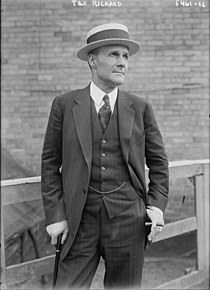
Tex Rickard

After its year long debut in Chicago, this revolver came into the hands on one Mr. Tex Rickard.  Tex was a wealthy man thanks to his gold mines.  Tex had traveled several times to Alaska after various discoveries of gold in Klondike and Nome.  After selling his holdings, he opened the Northern Saloon in Klondike, but would soon lose everything to gambling.  After working some odd jobs, he began promoting boxing matches and would eventually become one of the world's most well-known promoters.  He was the Don King of his day.  His excellence in promoting would lead him to start a life-long friendship with Wyatt Earp, promote for Heavyweight Champion Jack Dempsey, and bring boxing to its peak of popularity in the 1920's.  Before all of that, in 1906 Tex had chased the gold rush in a town recently renamed Goldfield.  There he started a bar named the Great Northern Saloon, a tribute to the bar he once lost, began his boxing promoter career, threw celebrations, and met a man named Claude C. Inman, to whom he would later give this pistol as a gift.  As his promoting career took off Tex would eventually obtain the rights to promote fights in Madison Square Garden, start the NHL New York Rangers hockey team, and build the third reincarnation of Madison Square Garden.


Claude C. Inman was a true pioneer.  He arrived in a mining camp named "Grandpa" with a load of lumber and the hunch that this area would soon strike a boom.  A tall, soft-spoken man he built the town's first frame building and drove its first nail with a bullet from his six shooter at thirty paces.  He would later call his demonstration "peace insurance."  Soon he would open for business as a carpenter and builder for the miners and their families, who were still living in tents at that time and paying him with everything but money.  Offered five times the sum required, he refused to build a saloon and instead focused on the town's first civic job: a water tank.  It wasn't too long before Inman brought back his family and started a life for himself in a town he had built with his own two hands.    Soon the town struck "high-grade" veins of gold, earning $200,000/ton, and the town boomed.  It changed its name to Goldfield and by 1904 it had produced about 800 tons of the lustrous ore.  Claude Inman held many hats in his town.  He was the first to organize labor in the area ($6/day and only 8 hours/day), he joined the school board in 1904, became the town's fire chief in 1905, battled several of the towns terrible fires in 1906, but shortly after was asked to take on a new job.

Goldfield, NV.  Notice the "Claude C. Inman for constable" banner over the street.

The town was booming and life in the Old West was tough.  20,000 people, twenty bars, access to gambling twenty-four hours a day, and a "red light district" with hundreds of prostitutes were all to be found in Goldfield.  It also had no shortage of opium dens, hoodlums, and miners stealing gold ore from the mines known as "highgraders."  Inman recalls that he "saw men on the way back from the mines with the handles on their lunch boxes bent like strings - they were that heavy with gold ore."  It didn't take long for the 350 mine owners to hold a meeting to discuss the problem, start cussing up a storm, and finally nominate Inman to clean up the town.  He wanted to talk to his wife, but the next morning the headlines already read 'INMAN ACCEPTS' even though Inman states, "Hell, I hadn't said a word."  January 1, 1906 Inman became the law for "a town that had more crooks and killers per capita than any other in American history; a town so fabulously rich that criminals from all over the world came to get a slice of its golden pie."  They persuaded Inman with an offer of pay that was a $10,000 per month guarantee or 40% of all the gold he recovered though Inman says, "There was never any more talk about the guarantee.  The percentage was always higher than $10,000."  After several "Untouchables" style raids and discoveries of secret trap doors, hidey holes, and other devices used to smuggle the gold (including travel trunks with secret compartments), the highgraders decided to hire a hitman to take out Inman.  It would not be the only time.  Inman describes it best.

"A little while after I took over the highgraders hired a man to get me.  I saw him when he came into town - sort of a dudish cuss.  I didn't let him see me and ducked into a saloon. Had a bar about 40, 50 feet long.  I remember the gaming tables.  A very nice place for that day and age.  Anyway, I had got down quite a ways behind the bar and was sitting there talking when somebody yelled 'Look out!'  I turned and this fellow started shooting.  There was something very peculiar and just that quick I realized that the fellow could not hit me.  I stepped behind the bar, waiting for the smoke to clear so I could do a little business.  He got two shots in - couldn't hit the side of a house...I commenced to get sore about this.  I stepped right out in full view and I walked right up to him and he stood there with the gun down at his side, smoking.  I told him not to raise his gun again, or I would kill him.  He didn't.
     He will never be more like a corpse than he was then.  The gun was down in his hand.  I walked up to him and took the gun out of his hand and laid it on the bar.  I said to the bartender, "Give us a drink.  'What are you doing there anyhow?'  He had been down in the metal tank under the bar.  The metal tanks had been built there, so that barkeepers could duck down.  He crawled out and was very peeved.  'You had better give us a drink.  This man's nerves are bad.  Put his gun out of the way.  He will never need it again."

After their drink, Inman took the man back to his office and "told him if he'd promise to get a decent job, I'd let him go.  He disappeared a few weeks later like a million others... He said 'I am going to remember this."  That was in 1906.  Two years later, in 1908, when I went to Boise to see this aviation meet, I was at the hotel and walked out, when I met a man face to face and he was spellbound.
     He said, "Aren't you Mr. Inman?"
     I said, "Yes."  He turned a liver color for a second.
     He said, "Do you know me?"
     I said, "I don't know you.  Your face is familiar, but I don't know you."
     He said, Have you got a minute to spare?  Come take a walk with me."  We went into the street and walked up the block and a half and there was a little store, nicely fixed up (electrical fixtures and plumbing).  We went in (his name was on the door) and it was a nice, clean, up-to-date store and full of goods and we took a glance around and walked on through and he opened another door in the back end of the store.
     He said, "My dear, come here.  I want to show you something."  There was a woman of small stature and with a curly-haired baby in her arms, with another girl about two years old by her side.
     He said, "Chief, this is my wife.  My dear, do you remember I told you about the policeman?"  She looked at me a minute and tears came streaming down her face.  I said, "You should not feel that way about it."
     She said, "I cannot help it.  You will never know what you have done for us."  This was the man that had come to Goldfield to kill me.  He had gone straight and was one of the highly respected men of the town and had a good business."


Inman even had Wyatt Earp himself offer his service for hire to clean up the town after he had so famously cleaned up Tombstone and Dodge City.  Earp nicknamed Goldfield "Hell's Flats" and urged Inman to allow him and a dozen men to root out the bad apples.  However, Inman knew they would be hopelessly outgunned and that the town couldn't be swept clean with the barrel of a gun.  Instead, he famously opted for capturing criminals instead of killing them, stings to catch them unaware, and using a conversational and pleasant demeanor.  Tex Rickard claimed once that Inman "could do more with friendly persuasion than most sheriffs could with a posse and make more friends than a politician at a banquet."  Maybe it was the way that Inman cleaned up the town, maybe it was the way he selflessly fought its disastrous fires, maybe it was the way he dealt with the Union mobs, or maybe it was the gentle way he spoke, but in February 1907 Goldfield paid tribute to the man that had done so much more them in a little over one year.  Inman was presented with the Smith & Wesson, Gustave Young engraved and gold inlaid, double action .44 Frontier revolver, that had been on display at Chicago's Columbian Exposition in 1893. However, to better show their appreciation, the townsfolk had luxurious Tiffany snakeskin grips put on the revolver by Tiffany & Co. in New York City.  Inman patrolled the town until January 1, 1909 when he retired a wealthy man.

The stories listed above are a mere drop in the bucket. The documentation that comes with this firearm truly give a glimpse into the life of this amazing man and his captivating, numerous stories.

After Inman
Claude Inman owned that revolver the rest of his life until he passed in July of 1962 and it passed to his son.  Since then it has passed through a few collections and appeared in several notable publications.  Perhaps most notably is is R.L. Wilson's The Peacemakers: Arms and Adventure in the American West.  From the 1893 Columbia Exhibition to the Gold Mines of Nevada, it now finds it path going through Rock Island Auction Company, the #1 firearms house in the world.  Whose collection will be fortunate enough to welcome this collectable with infinite tales to tell?  Will the new owner be able to add stories just as exciting?  Perhaps one day we'll find out or better yet, perhaps we'll go out and make some stories of our own.