
The most exciting part of collecting firearms is the histories. That's right, plural. Multiple histories. The first being the history of a particular model of firearm and the role it played (e.g. the M1 Garand), and the second being the history and ownership chain of a specific firearm (i.e. a gun owned by a famous person, was in a notable collection or book). This week's blog features a gun so rich in history, so rife with notable names that I almost entitled this article, "A Plethora of Provenance."
It has led more than a charmed life and has enjoyed fame in multiple unique spotlights over its life. This gun becomes truly special because it has all the documents to back its claims of grandeur. To show just how much documentation is coming with this beautiful revolver, here is a picture of MOST of it spread over my desk before I began research.

Origin
It all begins with the factory letter signed by renowned Smith & Wesson Historian, collector, and author Roy G. Jinks. His letter offers more than just the standard "birth certificate" fare of date of manufacture, serial number, etc. Instead, Jinks states that this particular revolver was engraved and gold inlaid by none other than famed Master Engraver Gustave Young. Young was Colt’s primary engraver in the 1850s to 1870s, but later went to work for the firm of Smith & Wesson during the 1870s through the 1890s. It is not unheard of for his pieces to sell for six figures and beyond. Mr. Jinks' letter also states that this particular firearm is a "display show gun sample." One would scarcely have time to wonder where it was being displayed before that curiosity is dispelled in the letter: "the Columbian Exposition in Chicago, Illinois in 1893." In other words, The World's Fair.
Smith & Wesson had chosen this gun as one of precious few to be seen by millions of people as they attended the exposition. For an exhibitor, and a city, it was truly their time to shine. Host cities would frequently exhibit new sculpture, feats of manufacture, architectural design, music, culture, inventions, and culinary feats. For example, at the 1893 World's Fair alone the following inventions debuted: Cracker Jack, phosphorescent lamps, the Ferris Wheel, Cream of Wheat, US Mint commemorative coins, Juicy Fruit gum, the electric chair, Pabst Blue Ribbon, Quaker Oats, and Shredded Wheat. To this powerhouse event of invention and spectacle, Smith & Wesson elected to send this and several other firearms. They had to put their best foot forward and they did by sending their finest.
Life
After its year long debut in Chicago, this revolver came into the hands on one Mr. Tex Rickard. Tex was a wealthy man thanks to his gold mines. Tex had traveled several times to Alaska after various discoveries of gold in Klondike and Nome. After selling his holdings, he opened the Northern Saloon in Klondike, but would soon lose everything to gambling. After working some odd jobs, he began promoting boxing matches and would eventually become one of the world's most well-known promoters. He was the Don King of his day. His excellence in promoting would lead him to start a life-long friendship with Wyatt Earp, promote for Heavyweight Champion Jack Dempsey, and bring boxing to its peak of popularity in the 1920's. Before all of that, in 1906 Tex had chased the gold rush in a town recently renamed Goldfield. There he started a bar named the Great Northern Saloon, a tribute to the bar he once lost, began his boxing promoter career, threw celebrations, and met a man named Claude C. Inman, to whom he would later give this pistol as a gift. As his promoting career took off Tex would eventually obtain the rights to promote fights in Madison Square Garden, start the NHL New York Rangers hockey team, and build the third reincarnation of Madison Square Garden.
Claude C. Inman was a true pioneer. He arrived in a mining camp named "Grandpa" with a load of lumber and the hunch that this area would soon strike a boom. A tall, soft-spoken man he built the town's first frame building and drove its first nail with a bullet from his six shooter at thirty paces. He would later call his demonstration "peace insurance." Soon he would open for business as a carpenter and builder for the miners and their families, who were still living in tents at that time and paying him with everything but money. Offered five times the sum required, he refused to build a saloon and instead focused on the town's first civic job: a water tank. It wasn't too long before Inman brought back his family and started a life for himself in a town he had built with his own two hands. Soon the town struck "high-grade" veins of gold, earning $200,000/ton, and the town boomed. It changed its name to Goldfield and by 1904 it had produced about 800 tons of the lustrous ore. Claude Inman held many hats in his town. He was the first to organize labor in the area ($6/day and only 8 hours/day), he joined the school board in 1904, became the town's fire chief in 1905, battled several of the towns terrible fires in 1906, but shortly after was asked to take on a new job.
The town was booming and life in the Old West was tough. 20,000 people, twenty bars, access to gambling twenty-four hours a day, and a "red light district" with hundreds of prostitutes were all to be found in Goldfield. It also had no shortage of opium dens, hoodlums, and miners stealing gold ore from the mines known as "highgraders." Inman recalls that he "saw men on the way back from the mines with the handles on their lunch boxes bent like strings - they were that heavy with gold ore." It didn't take long for the 350 mine owners to hold a meeting to discuss the problem, start cussing up a storm, and finally nominate Inman to clean up the town. He wanted to talk to his wife, but the next morning the headlines already read 'INMAN ACCEPTS' even though Inman states, "Hell, I hadn't said a word." January 1, 1906 Inman became the law for "a town that had more crooks and killers per capita than any other in American history; a town so fabulously rich that criminals from all over the world came to get a slice of its golden pie." They persuaded Inman with an offer of pay that was a $10,000 per month guarantee or 40% of all the gold he recovered though Inman says, "There was never any more talk about the guarantee. The percentage was always higher than $10,000." After several "Untouchables" style raids and discoveries of secret trap doors, hidey holes, and other devices used to smuggle the gold (including travel trunks with secret compartments), the highgraders decided to hire a hitman to take out Inman. It would not be the only time. Inman describes it best.
"A little while after I took over the highgraders hired a man to get me. I saw him when he came into town - sort of a dudish cuss. I didn't let him see me and ducked into a saloon. Had a bar about 40, 50 feet long. I remember the gaming tables. A very nice place for that day and age. Anyway, I had got down quite a ways behind the bar and was sitting there talking when somebody yelled 'Look out!' I turned and this fellow started shooting. There was something very peculiar and just that quick I realized that the fellow could not hit me. I stepped behind the bar, waiting for the smoke to clear so I could do a little business. He got two shots in - couldn't hit the side of a house...I commenced to get sore about this. I stepped right out in full view and I walked right up to him and he stood there with the gun down at his side, smoking. I told him not to raise his gun again, or I would kill him. He didn't.
He will never be more like a corpse than he was then. The gun was down in his hand. I walked up to him and took the gun out of his hand and laid it on the bar. I said to the bartender, "Give us a drink. 'What are you doing there anyhow?' He had been down in the metal tank under the bar. The metal tanks had been built there, so that barkeepers could duck down. He crawled out and was very peeved. 'You had better give us a drink. This man's nerves are bad. Put his gun out of the way. He will never need it again."
After their drink, Inman took the man back to his office and "told him if he'd promise to get a decent job, I'd let him go. He disappeared a few weeks later like a million others... He said 'I am going to remember this." That was in 1906. Two years later, in 1908, when I went to Boise to see this aviation meet, I was at the hotel and walked out, when I met a man face to face and he was spellbound.
He said, "Aren't you Mr. Inman?"
I said, "Yes." He turned a liver color for a second.
He said, "Do you know me?"
I said, "I don't know you. Your face is familiar, but I don't know you."
He said, Have you got a minute to spare? Come take a walk with me." We went into the street and walked up the block and a half and there was a little store, nicely fixed up (electrical fixtures and plumbing). We went in (his name was on the door) and it was a nice, clean, up-to-date store and full of goods and we took a glance around and walked on through and he opened another door in the back end of the store.
He said, "My dear, come here. I want to show you something." There was a woman of small stature and with a curly-haired baby in her arms, with another girl about two years old by her side.
He said, "Chief, this is my wife. My dear, do you remember I told you about the policeman?" She looked at me a minute and tears came streaming down her face. I said, "You should not feel that way about it."
She said, "I cannot help it. You will never know what you have done for us." This was the man that had come to Goldfield to kill me. He had gone straight and was one of the highly respected men of the town and had a good business."

Inman even had Wyatt Earp himself offer his service for hire to clean up the town after he had so famously cleaned up Tombstone and Dodge City. Earp nicknamed Goldfield "Hell's Flats" and urged Inman to allow him and a dozen men to root out the bad apples. However, Inman knew they would be hopelessly outgunned and that the town couldn't be swept clean with the barrel of a gun. Instead, he famously opted for capturing criminals instead of killing them, stings to catch them unaware, and using a conversational and pleasant demeanor. Tex Rickard claimed once that Inman "could do more with friendly persuasion than most sheriffs could with a posse and make more friends than a politician at a banquet." Maybe it was the way that Inman cleaned up the town, maybe it was the way he selflessly fought its disastrous fires, maybe it was the way he dealt with the Union mobs, or maybe it was the gentle way he spoke, but in February 1907 Goldfield paid tribute to the man that had done so much more them in a little over one year. Inman was presented with the Smith & Wesson, Gustave Young engraved and gold inlaid, double action .44 Frontier revolver, that had been on display at Chicago's Columbian Exposition in 1893. However, to better show their appreciation, the townsfolk had luxurious Tiffany snakeskin grips put on the revolver by Tiffany & Co. in New York City. Inman patrolled the town until January 1, 1909 when he retired a wealthy man.
The stories listed above are a mere drop in the bucket. The documentation that comes with this firearm truly give a glimpse into the life of this amazing man and his captivating, numerous stories.
After Inman
Claude Inman owned that revolver the rest of his life until he passed in July of 1962 and it passed to his son. Since then it has passed through a few collections and appeared in several notable publications. Perhaps most notably is is R.L. Wilson's The Peacemakers: Arms and Adventure in the American West. From the 1893 Columbia Exhibition to the Gold Mines of Nevada, it now finds it path going through Rock Island Auction Company, the #1 firearms house in the world. Whose collection will be fortunate enough to welcome this collectable with infinite tales to tell? Will the new owner be able to add stories just as exciting? Perhaps one day we'll find out or better yet, perhaps we'll go out and make some stories of our own.

 |
| Extraordinary Documented Gustave Young's 1893 Chicago World's Fair Exposition Engraved and Gold Inlaid Smith & Wesson 44 Double Action Frontier Model Revolver with Nevada Gold Mining Lawmen History |
It has led more than a charmed life and has enjoyed fame in multiple unique spotlights over its life. This gun becomes truly special because it has all the documents to back its claims of grandeur. To show just how much documentation is coming with this beautiful revolver, here is a picture of MOST of it spread over my desk before I began research.
Origin
It all begins with the factory letter signed by renowned Smith & Wesson Historian, collector, and author Roy G. Jinks. His letter offers more than just the standard "birth certificate" fare of date of manufacture, serial number, etc. Instead, Jinks states that this particular revolver was engraved and gold inlaid by none other than famed Master Engraver Gustave Young. Young was Colt’s primary engraver in the 1850s to 1870s, but later went to work for the firm of Smith & Wesson during the 1870s through the 1890s. It is not unheard of for his pieces to sell for six figures and beyond. Mr. Jinks' letter also states that this particular firearm is a "display show gun sample." One would scarcely have time to wonder where it was being displayed before that curiosity is dispelled in the letter: "the Columbian Exposition in Chicago, Illinois in 1893." In other words, The World's Fair.
 |
| Chicago went all out! |
Life
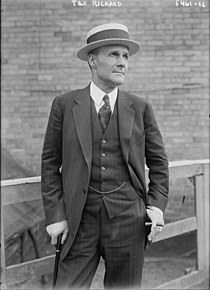 |
| Tex Rickard |
After its year long debut in Chicago, this revolver came into the hands on one Mr. Tex Rickard. Tex was a wealthy man thanks to his gold mines. Tex had traveled several times to Alaska after various discoveries of gold in Klondike and Nome. After selling his holdings, he opened the Northern Saloon in Klondike, but would soon lose everything to gambling. After working some odd jobs, he began promoting boxing matches and would eventually become one of the world's most well-known promoters. He was the Don King of his day. His excellence in promoting would lead him to start a life-long friendship with Wyatt Earp, promote for Heavyweight Champion Jack Dempsey, and bring boxing to its peak of popularity in the 1920's. Before all of that, in 1906 Tex had chased the gold rush in a town recently renamed Goldfield. There he started a bar named the Great Northern Saloon, a tribute to the bar he once lost, began his boxing promoter career, threw celebrations, and met a man named Claude C. Inman, to whom he would later give this pistol as a gift. As his promoting career took off Tex would eventually obtain the rights to promote fights in Madison Square Garden, start the NHL New York Rangers hockey team, and build the third reincarnation of Madison Square Garden.
Claude C. Inman was a true pioneer. He arrived in a mining camp named "Grandpa" with a load of lumber and the hunch that this area would soon strike a boom. A tall, soft-spoken man he built the town's first frame building and drove its first nail with a bullet from his six shooter at thirty paces. He would later call his demonstration "peace insurance." Soon he would open for business as a carpenter and builder for the miners and their families, who were still living in tents at that time and paying him with everything but money. Offered five times the sum required, he refused to build a saloon and instead focused on the town's first civic job: a water tank. It wasn't too long before Inman brought back his family and started a life for himself in a town he had built with his own two hands. Soon the town struck "high-grade" veins of gold, earning $200,000/ton, and the town boomed. It changed its name to Goldfield and by 1904 it had produced about 800 tons of the lustrous ore. Claude Inman held many hats in his town. He was the first to organize labor in the area ($6/day and only 8 hours/day), he joined the school board in 1904, became the town's fire chief in 1905, battled several of the towns terrible fires in 1906, but shortly after was asked to take on a new job.
 |
| Goldfield, NV. Notice the "Claude C. Inman for constable" banner over the street. |
The town was booming and life in the Old West was tough. 20,000 people, twenty bars, access to gambling twenty-four hours a day, and a "red light district" with hundreds of prostitutes were all to be found in Goldfield. It also had no shortage of opium dens, hoodlums, and miners stealing gold ore from the mines known as "highgraders." Inman recalls that he "saw men on the way back from the mines with the handles on their lunch boxes bent like strings - they were that heavy with gold ore." It didn't take long for the 350 mine owners to hold a meeting to discuss the problem, start cussing up a storm, and finally nominate Inman to clean up the town. He wanted to talk to his wife, but the next morning the headlines already read 'INMAN ACCEPTS' even though Inman states, "Hell, I hadn't said a word." January 1, 1906 Inman became the law for "a town that had more crooks and killers per capita than any other in American history; a town so fabulously rich that criminals from all over the world came to get a slice of its golden pie." They persuaded Inman with an offer of pay that was a $10,000 per month guarantee or 40% of all the gold he recovered though Inman says, "There was never any more talk about the guarantee. The percentage was always higher than $10,000." After several "Untouchables" style raids and discoveries of secret trap doors, hidey holes, and other devices used to smuggle the gold (including travel trunks with secret compartments), the highgraders decided to hire a hitman to take out Inman. It would not be the only time. Inman describes it best.
"A little while after I took over the highgraders hired a man to get me. I saw him when he came into town - sort of a dudish cuss. I didn't let him see me and ducked into a saloon. Had a bar about 40, 50 feet long. I remember the gaming tables. A very nice place for that day and age. Anyway, I had got down quite a ways behind the bar and was sitting there talking when somebody yelled 'Look out!' I turned and this fellow started shooting. There was something very peculiar and just that quick I realized that the fellow could not hit me. I stepped behind the bar, waiting for the smoke to clear so I could do a little business. He got two shots in - couldn't hit the side of a house...I commenced to get sore about this. I stepped right out in full view and I walked right up to him and he stood there with the gun down at his side, smoking. I told him not to raise his gun again, or I would kill him. He didn't.
He will never be more like a corpse than he was then. The gun was down in his hand. I walked up to him and took the gun out of his hand and laid it on the bar. I said to the bartender, "Give us a drink. 'What are you doing there anyhow?' He had been down in the metal tank under the bar. The metal tanks had been built there, so that barkeepers could duck down. He crawled out and was very peeved. 'You had better give us a drink. This man's nerves are bad. Put his gun out of the way. He will never need it again."
After their drink, Inman took the man back to his office and "told him if he'd promise to get a decent job, I'd let him go. He disappeared a few weeks later like a million others... He said 'I am going to remember this." That was in 1906. Two years later, in 1908, when I went to Boise to see this aviation meet, I was at the hotel and walked out, when I met a man face to face and he was spellbound.
He said, "Aren't you Mr. Inman?"
I said, "Yes." He turned a liver color for a second.
He said, "Do you know me?"
I said, "I don't know you. Your face is familiar, but I don't know you."
He said, Have you got a minute to spare? Come take a walk with me." We went into the street and walked up the block and a half and there was a little store, nicely fixed up (electrical fixtures and plumbing). We went in (his name was on the door) and it was a nice, clean, up-to-date store and full of goods and we took a glance around and walked on through and he opened another door in the back end of the store.
He said, "My dear, come here. I want to show you something." There was a woman of small stature and with a curly-haired baby in her arms, with another girl about two years old by her side.
He said, "Chief, this is my wife. My dear, do you remember I told you about the policeman?" She looked at me a minute and tears came streaming down her face. I said, "You should not feel that way about it."
She said, "I cannot help it. You will never know what you have done for us." This was the man that had come to Goldfield to kill me. He had gone straight and was one of the highly respected men of the town and had a good business."
Inman even had Wyatt Earp himself offer his service for hire to clean up the town after he had so famously cleaned up Tombstone and Dodge City. Earp nicknamed Goldfield "Hell's Flats" and urged Inman to allow him and a dozen men to root out the bad apples. However, Inman knew they would be hopelessly outgunned and that the town couldn't be swept clean with the barrel of a gun. Instead, he famously opted for capturing criminals instead of killing them, stings to catch them unaware, and using a conversational and pleasant demeanor. Tex Rickard claimed once that Inman "could do more with friendly persuasion than most sheriffs could with a posse and make more friends than a politician at a banquet." Maybe it was the way that Inman cleaned up the town, maybe it was the way he selflessly fought its disastrous fires, maybe it was the way he dealt with the Union mobs, or maybe it was the gentle way he spoke, but in February 1907 Goldfield paid tribute to the man that had done so much more them in a little over one year. Inman was presented with the Smith & Wesson, Gustave Young engraved and gold inlaid, double action .44 Frontier revolver, that had been on display at Chicago's Columbian Exposition in 1893. However, to better show their appreciation, the townsfolk had luxurious Tiffany snakeskin grips put on the revolver by Tiffany & Co. in New York City. Inman patrolled the town until January 1, 1909 when he retired a wealthy man.
The stories listed above are a mere drop in the bucket. The documentation that comes with this firearm truly give a glimpse into the life of this amazing man and his captivating, numerous stories.
After Inman
Claude Inman owned that revolver the rest of his life until he passed in July of 1962 and it passed to his son. Since then it has passed through a few collections and appeared in several notable publications. Perhaps most notably is is R.L. Wilson's The Peacemakers: Arms and Adventure in the American West. From the 1893 Columbia Exhibition to the Gold Mines of Nevada, it now finds it path going through Rock Island Auction Company, the #1 firearms house in the world. Whose collection will be fortunate enough to welcome this collectable with infinite tales to tell? Will the new owner be able to add stories just as exciting? Perhaps one day we'll find out or better yet, perhaps we'll go out and make some stories of our own.


