Search This Blog

Showing posts with label Gustave Young. Show all posts

Friday, August 12, 2016

The Silver Winchester of Ira Paine, "Master Shooter of the World"

Lot 3014: Documented Extremely Rare Exhibition Panel Scene Factory Engraved German Silver Frame Winchester Model 1866 Lever Action Rifle with Factory Letter Connected to Exhibition Shooter Chevalier Ira Paine

Not many people today know the name of Ira A. Paine. No further proof of that fact is needed in this information age than when the man doesn't even have his own Wikipedia page. Now that's obscure! He has no biography, official or otherwise, and few readily available materials exist on the man outside of a handful of early 20th century articles of his contest results and his eventual obituary. Even information as basic as the man's middle name is disputed (Anson? Albert? Abner?). Unsung as Ira Paine is today, he was far from some nobody off the street. In his day, he was nicknamed, "The Master Shooter of the World" and "King of the Pistol." His feats with rifle, shotgun, or pistol  were legendary and seldom has such proficiency existed then or since. He was showered with awards and heralded by heads of state and royalty the world around. Truly a forgotten master of the shooting arts, Mr. Paine has largely gone the way as his hobby and descended into obscurity.

Ira Paine
In the limited materials available on Paine, it is never specifically mentioned that he was born into
wealth, however, this is no doubt the case. On February 11, 1837 he was born in Hebronville, Massachusetts to Ira Sr. and Elizabeth Paine. Hebronville was a mill village in southwestern, Attleboro, very near the larger towns of Pawtucket and Providence, both located in nearby Rhode Island. This has often resulted in some confusion as to the man's true birthplace. Little is mentioned of Paine's young life other than he became an accomplished plumber and gas fitter, specifically mentioned in his obituary as "one of the finest in the state." Granted, this does not initially sound like a blue blood upbringing, but soon his interested ventured into solo voice and young Ira became a highly educated professional vocalist with an outstanding tenor sound. His professional performances with a vocal quartet are documented and brought him further acclaim. It is claimed in several sources that Paine performed in minstrel shows, but this author has not seen any evidence to either confirm or deny.

 His education already varied from plumbing to vocal technique, yet Paine was satisfied by neither. He took a strong interest in the outdoors, which branched into firearms. He would retreat to the woods and practice shooting voraciously when not at work, resulting in his rapid ascension at a local yacht club's pigeon shoots. At the time, target shooting was considered a refined sport for gentlemen and ladies.  Most universities fielded shooting teams and the popularity of the sport was immense. Such popularity has not escaped the eye of history; noted Smith & Wesson Historian Roy Jinks once wrote, "The rivalry between the Harvard and Yale pistol teams was as great as it was in football."

Young Paine quickly became a top member and the club would pit him against the top shots of other clubs, earning both the yacht club and Paine many accolades. Not just satisfied with his proficiency with the shotgun, he quickly also became a crack shot with the rifle as well as the pistol. Paine took a particular delight in his expertise with a pistol, because while numerous sharp shots existed with a rifle or shotgun, very few showed mastery over the pistol. Ambidextrous with any firearm, Paine was performing shots that witnesses had previously thought impossible and this was to be a common theme throughout his illustrious career. Around this time Paine married his wife who would play a large role in his early shows. Not documented until now, vital records from Massachusetts show that Paine was married to Margaret E. McLaughlin on August 21, 1856 in the city of Worcester. The very next year, they had their first child, a daughter named Marietta F. Paine.


It was at this time of incredible local success that Paine decided forgo his career in the arts to take his guns on the road to become a professional exhibition and competition shooter. The transition from competitive shooter to exhibition shooter may be lost to time, but it is easy to assume that Paine went on to experience further success at larger, regional contests to further build his fame and draw. A 1917 copy of the Nation Rifle Associations "Arms and the Man" magazine states the following of Paine's first tour.

"During his first tours of this country he used a Stevens pistol exclusively. Some of his favorite shots at that time included breaking a small glass ball at 12 yards; shooting glass balls the size of a walnut from the top of a helmet worn by his wife while she walked about the stage; smashing swinging balls; shooting the "spots" from playing cards held by his wife, and then splitting the card, when held edgewise by a single accurate line shot."

These dangerous and outstanding exhibitions of skill with his Stevens Lord Model pistol earned Paine his well-deserved fame and he was soon holding performances in every major city across the country. This new career began in 1860, but it is not documented how the 23-year old Paine avoided service in the Civil War.

In this early stage in his career, the .22 caliber sized holes in his targets from his Stevens pistol were often too small for the audience to clearly see. Even though using a smaller caliber was more difficult, he switched to a larger cartridge. He first used a dueling pistol made by fine Parisian gunsmith Gastinne Renette, but apparently found it unsatisfactory. Historian Roy Jinks states that Paine worked tirelessly with the manufacturer to determine the most accurate revolver. Reportedly after the two had fired thousands of rounds and carefully documenting their results, they came to the conclusion that the Smith & Wesson New Model No. 3 would be Paine's new tool of his trade. Renette and Paine shared a mutual respect and would remain friends.

By 1866 he had traveled to Europe to take on the top shots of the British military in head-to-head competition. He bested their Captain Patten and Captain Skelly and now the fame of the one-time plumber spanned nations. He would spend the next several years in Europe performing and showing his skills before kings, queens, czars, military men, and other sharp shots. Paine remained in Europe for over six years performing in every capitol city and royal palace, astounding his audiences along the way.

From available sources one infers that Paine then returned to the states to give his homeland another taste of the shows his European audiences had so enjoyed. His obituary states that the same year of his return, 1872, that Paine "became champion pistol shot of the United States." Throughout the 1870s he enjoyed a good many challenges and rivalries, most notably against Captain Adam Bogartus, an expert with the shotgun. The exploits of the two and their competitions defines a level of expertise that defies comprehension. Bogartus won the majority of the matches, but even those were seldom by more than 2 birds. The high publicity matches between the two, dating back to 1871, were also an excellent chance to develop some of the new inventions of recreational shooting such as the glass ball, the trap, and the clay pigeon. Both Cpt. Bogardus and Paine made contributions to the trap device and ball, but neither can claim either invention, despite claims in both camps to the contrary. Paine took to the glass balls early, as did audiences, and he would often fill them with feathers that would erupt in a spectacular burst that thrilled the crowds that still liked to "see the feathers fly" from when live birds were used in the shooting exhibitions.

However, it is also in the 1870s that Paine's life takes some unexpected personal turns. After hiatus from census records for some time, he pops up on the 1870 Federal census with his wife Margaret and their daughter Marietta F. Paine, as living in Rhode Island and with Ira's occupation listed as "gas fitter." On August 12, 1872, Marietta married one Mr. Albert Henry Wakefield in Johnston, RI where the marriage certificate lists her age as a tender 15. Mr. Wakefield was 23. A quick scan for marriage licenses reveals that the Ira Paine married Annie Ratlidge Parker Collins, a 29-year old widow from Massachusetts. The two were married on January 20, 1875, in Brooklyn. Unfortunately there was not adequate time before this article published for a proper investigation for the result of Mr. Paine's first marriage to Margaret. It may have ended in her death, a divorce, or may have even been supplanted by the beginning of a second family during Paine's many travels. No death record exists for Margaret in Massachusetts, so she may have died in nearby Rhode Island, or the two could've simply divorced. To muddy the waters even further, Paine's obituary also mentions a marriage to "Miss Anna Marchant while abroad," around 1883. No further information could be located on this potential third marriage (or confusion of his second marriage) at this time.


Unclear personal life aside, Ira Paine left the United States again in 1881, and set out again once more to thrill the crowds of Europe. He again made appearances in nearly every major city "such as Brussels, Paris, Berlin, Bordeaux, Madrid, Barcelona, Lisbon, Hanover, Breslau, St. Petersburg, Moscow, Warsaw," and many English cities. However, it was General Von Kameke, the German Minister of War, who on March 12, 1882, "in the presence of the Royal Family and 4,000 troops, pronounced him 'the most wonderful shot the world has ever seen.'" On December 8 of that same year, "he was knighted and decorated by the King of Portugal at Lisbon in the presence of the American Minister," - a reward for Paine's fine exhibition for the King who joined Paine in some shooting after the show. It was during this same performance that the King of Portugal made Ira a chevalier of an ancient military order. When researching Paine it is impossible to not find him referred to as Chevalier Ira Paine.


He would shoot at the most prominent European armorers and manufacturers of the day. He defended his honor in Paris after accusations flew that his wife was little more than a magician's assistant, and aiding Paine's "shots" via trickery or slight of hand. He bested famed duelist Henri Cartier at the Gastinne Renette gallery, and demolished Josef Schulof in Vienna. It is documented that when leaving Vienna, Paine, "was fairly loaded with souvenirs" and that "the five judges of the great pistol match... presented him with a magnificent gold medal, inscribed, 'The Master Shot of the World; from Vienna Friends.'" After four years abroad, Chevalier Paine again returned home to the United States and began plying his exhibition shooting act in a traveling circus known as "Frank A. Robbins' New Shows, Museum, 2-Ring Circus, and Monster Menagerie."


The general manager of this circus was one Mr. William L. Loper. According to Mr. Loper's descendants, one summer around 1888, "Robbins and his girlfriend absconded with the season's receipts and fled to Canada," leaving Loper to "pay off the performers and help get what was left of the circus to Frenchtown, New Jersey, where the circus wintered." Robbins would go on to form other circuses and carnivals until his untimely death in 1920 after falling through a skylight and plunging 20 feet to his doom.

William Loper on the other hand would become a fast friend of Paine. It could've been the two were natural colleagues or perhaps Paine was showing his appreciation to Loper for holding the circus together after Robbins' ill-advised departure, but whatever the case, Paine gave this Winchester to Loper at that time and it has remained in the family ever since - approximately 128 years. Loper passed this incredible rifle on to his daughter, who in turn bequeathed it to her grandson. This rifle has never been seen or offered to the public in that time.

Chevalier Ira Paine passed away suddenly the very next year, in 1889 while in Paris, France. It is thought to have been heart trouble attributed to his stout figure and obesity, though a conclusive cause of death is not documented for history.


The Gun


This incredible Winchester likely began its life in 1870 based on its 36200, hand engraved serial number. The notes of its factory record state that it is a

"Special gun transferred from back book
Received in warehouse on (no date recorded)
Shipped from warehouse on May 6, 1878"


This may indicate that this gun was held and maintained at the factory and was likely used as an exhibition piece. One look at the rifle clearly shows that this is a distinct possibility. Upon first glance, the gun may appear to have a silver plating. However, after careful inspection Rock Island Auction Company is astounded to reveal that this 1866 rifle possesses a solid German silver frame, one of two known. Engraving is attributed to Gustave Young and is some of his finest work. Not coincidentally, it could be considered a companion piece to Winchester 1866 serial number 26283, also attributed to Young by R. L. Wilson. SN 26283 is generally considered Young's masterpiece and one of the finest Winchesters ever created. Both unsigned rifles appear to be cut by the same master, a distinction inferred from their scroll similarities, the light hand used in each, and the unique depth of field utilized in the panel scenes. Both rifles are also marked by a distinct rear sight.

A comparison between the Ira Paine rifle and Winchester SN 26283. Top photo taken from
R.L. Wilson's book "Winchester Engraving"


Floral scrollwork covers nearly every surface of the silver frame, creeping up the barrel and forend before reappearing at the muzzle in abundance. In fact, barrels featuring this level of work are frequently seen on the vaunted "1 of 1,000" rifles. While solid German silver comprises the frame, cartridge elevator, and forend cap, other parts are plated in nickel such as the barrel and lever. The loading gate remains a vivid nitre blue and the hammer still displays hues of its case hardening.

But enough of what can be shown to you in photos. What makes this gun so incredible? Why is it so benchmark breaking? Besides the aforementioned solid German silver frame, a barrel that would not look out of place on a 1 of 1,000, and some of Gustave Young's finest work?

1. This is one of 24 Winchester 1866 rifles that letters.

2. Factory letter also states this gun has "3x checkering"on its "varnish finish" and highly figured walnut stock.

3. Not listed on the factory letter is the shotgun buttstock, another highly desirable, special order feature.

4. After Paine gave this rife to William P. Loper (circa 1888), it remained in that family ever since. That's 128 years! It has not been photographed or offered to the public in over a century!

5. Did we mention that Chevalier Ira A. Paine is actually photographed with this wondrous Winchester? With the abundance of silver, nickel, and the presence of a shotgun butt, the rifle offered by Rock Island Auction Company is unquestionably that seen in the below photo.


The Mystery

There are also some curious markings on this Winchester. The collector fortunate enough to take this masterpiece home will have some interesting detective work ahead of them.

1. Working hours?


When disassembling the firearm to verify its solid German silver frame, Rock Island Auction Company came across some utterly fascinating markings located on the side of the tang. Not visible when the gun is fully assembled, they indicate a daily occurrence in the month of July. Is this is a list kept by Gustave Young himself of the time spent on this gun? It is unknown at this time, but that certainly seems a reasonable speculation. If that is the case, it is also interesting to note how Young worked so diligently for so long, but then began taking breaks from this work before finishing it toward the end of that same month (the last scratching indicates July 27).


2. Roman Numerals?

Under the forestock is another curious marking: what appears to be the Roman numeral 14. Were this marking done in an area that disassembly was not required to access, one could safely assume it would have been "added" after it left the factory. After all, why would Winchester visibly mark one of their prized exhibition rifles in such a way? However, since this resides in a "hidden" area of the rifle, this author feels it safe to assume that the marking was placed their during its creation or time in the factory. Also, given some of the other markings in hidden areas, this could be yet another marking by Gustave Young. Debating its meaning is another matter entirely.


3. C 20?


Opposite the Roman numerals, on the corresponding barrel flat, under the forestock, appears "C 20."  Is this another factory designation? Another message from Young? All the other markings on the gun, including the serial number and address, are hand engraved, yet these are clearly stamped, especially when one sees the faint "0" behind the clearly stamped one. But were these stamped over Young's original markings? Looking closely at the "2" we can see a more "ghosted" two behind it. Is this another missed strike of a stamping or an attempt to clarify Young's writing, which in #1 was shown to have been quite informal at times?


This is truly an exceptional rifle, owned by a man nearly lost to history, that sets a benchmark all its own when it comes to rare, fresh, and absolutely incredible high end Winchester rifles. It's unclear what determines whether a famous shooter will be remembered. Why do we know names like Annie Oakley, the Famous Topperweins, Bob Munden, Jelly Bryce, or Herb Parsons and not sharp shots such as Paine or several of his contemporaries also mentioned in this article? The floor is open for theories and suggestions, but one thing remains certain: this ground breaking Winchester, finally revealed to the collecting public, will not be forgotten anytime soon.


-Written by Joel R. Kolander


SOURCES:

Himmelwright, Abraham Lincoln Artman. Pistol and Revolver Shooting. New York: Macmillan, 1915. Print.

https://familysearch.org/ark:/61903/1:1:24Z2-8JH

"
Ira Paine Dead." Evening Bulletin [Providence] 1889: n. pag. Print.

Jinks, Roy G., and Sandra C. Krein. Smith & Wesson: 1852-1965. Charleston, SC: Arcadia Pub., 2006. Print.

"Thirty Years Ago With the Hand-Gun, Part 2 - The Story of Ira Paine." Arms and the Man 16 June 1917: 225-26. Print. Vol. LXII, No. 12.

Wednesday, July 31, 2013

Gustave Young: Iconic Engraver

While we were attending The Colorado Gun Collector's 48th Annual Gun Show in Denver this past May, we took in quite a few consignments.  One of the items was not a gun, but was such a direct link to history and collector firearms that it immediately stole our attention.  At first glance, it appeared to be little more than a humble book with a simple, engraved silver shield adorning its front cover.  The gilted text on the spine read "ALBUM" and we were intrigued.
Historic Leather Bound and Silver Furnished Photo Album from the Household of Historic Master Engraver Gustave Young, as Documented by Noted Arms Historian R.L. Wilson, From His Personal Collection

This album would turn out to be none other than a family photo album of legendary engraver Gustave Young, the German-born artisan whose signature crisp scrollwork and beautiful designs would set a high standard for all future gun engravers.  The "MY" engraved on the silver shield stands for Marie Young, his wife, and the "dot and line" border on the shield is in the style of the master himself.  Inside are 63 photos of men, women, children and included with the photo album is a letter from renowned author and historian R.L. Wilson, telling the story how he found this historic album and came to possess it.

Gustave Young can be seen as a young, bearded man in the lower right photo.

Young immigrated to the United States in 1846, and would engrave for Colt from 1852 into the mid 1860's, mentor the then-apprentice Conrad Ulrich, leave Colt, and return to run his own shop full-time.  He would be commissioned by Smith & Wesson in 1865 and officially enter their employ from 1869 into the 1890's.  His stature then was almost equal to what it has become today.  He was once known to have thrown D.B. Wesson out of this work area yelling, "Get out of my shop!  You talk so much I can't work!"  One characteristic of a Gustave Young piece that has changed over the years: the price.  He once wrote a letter to Wesson stating that his work would take 5-6 days to complete and that his charge would be $50.00.  His works now command hundreds of thousands of dollars or more!  Oddly, these masterpiece creations were the engravers secondary job while employed at their respective factories.  Their primary task was to create the dies required to produce firearms.  Firearms historian Roy Jinks says, "The engraver was busy cutting letter and number stamping dies, hammer and trigger checkering cutters, and wheels for rolling the company name on top of the barrel.  Engraving and gold inlaying were secondary assignments, designed to increase revenue and help reduce the overhead of this expensive service."  Gustave would pass away on January 3, 1895, but had had two sons, Oscar and Eugene, that would continue his engraving legacy at Smith & Wesson until 1913.

Examine the following items.  Most of them were engraved and/or inlaid by Gustave himself, two were likely created by an engraver in his shop, but all are exceptional examples of American firearms craftsmanship.

Factory Engraved Colt Model 1851 Navy Revolver

One of two Colt 1851 Navy revolvers available in this auction, this is the earlier of the two having been manufactured in 1859.  This is a classic example of Gustave's style, showing off his European training in his trademark Germanic scrollwork on a punch-dot background.  He also included his signature Wolf's head design on the hammer as well as another animal head on the left side of the barrel lug - another well-known European design that has existed for centuries.  The contrast of the two toned metals is striking and the pistol finishes nicely with a handsome, one-piece, walnut grip.


Magnificent Sharps Panel Scene Gustave Young Engraved Model 1853 Percussion Sporting Rifle


This rifle was manufactured sometime between 1854 and 1856 and has the honor to be featured on page 103 of R.L. Wilson's book, "Steel Canvas."  He states in his book that the engraving, while performed in Young's shop, was probably executed by a worker other than Young himself.  It features engraving on the patchbox, hammer, breech end of the barrel, receiver, and the edge of the muzzle.  A trademark of Young's style, it also has nine dots stamped on it to indicate the level of embellishment.  Our consignor notes that only four model 1853 Model 1853 Sporting Rifles were made with "Extra Engraving."  Combine that with the fact that this gun is not a Colt nor Smith & Wesson and this gun becomes an especially rare example of an engraving connected to Young.  Also auctioned off with the rifle are the accessories and the original shipping box, still stamped on its lid with the owner's name and address!


Extraordinary Documented Gustave Young's 1893 Chicago World's Fair Exposition Engraved and Gold Inlaid Smith & Wesson 44 Double Action Frontier Model Revolver with Nevada Gold Mining Lawman History

Remember this Gustave Young engraved beauty?  We did a comprehensive write-up of its rich and amazing history earlier this month!  If you missed it the first time, consider this a great second chance to learn all about it.  You'll be glad you did.  Click here to open the article in a new window.


Factory Engraved Colt Model 1849 Pocket Revolver


Here the dots which Gustave and his shop used to indicate varying levels of ornamentation
can be seen on the hammer.
This Colt Pocket Revolver is a smaller firearm than the other featured pieces seen here, but it also manages to be saturated with textbook Gustave Young style.  The scrollwork, the wolf's head hammer, and punch dots on the hammer are all in-line with his work.  This revolver, while maintaining those characteristics as well as the stately, polished walnut handle, also has some features that the other guns in this article would be proud to possess.  The scroll scene is the Stagecoach Holdup scene and all visible screws are engraved on their heads, a feature absent on even the previous gun that was featured in the Columbian Exposition.  This revolver's brass trigger guard and backstrap, in addition to being engraved, are also silver plated.  It's another classic example of Young's style that any collector would be privileged to have in their collection.


Fine Cased Gustave Young Factory Engraved Colt Model 1851 Navy Revolver with Factory Letter


The later of the two Colt 1851 Navy revolvers in our September 2013 Premiere Auction, this particular specimen still enjoys the comforts of its case and the company of its accessories.  A subtle difference between the two is the factory marking indicating that the firearm was to be engraved.  On the earlier model, a simple square shaped punch is placed in several locations, but on this model the punch has since been replaced by the letter "E" for "engraved" or other special finishes.  The amount of finish on the gun is impressive as are the touches of casehardening that grace the receiver, trigger, and screws.  The walnut grip shines with polish and its wood grains were well-chosen to finish out this becoming firearm.

One of the many animal heads that Young would incorporate in his scrollwork, a technique
European engravers have used for centuries.


Rare Early Production Colt Model 1 1855 Sidehammer Pocket Revolver with Hand Engraved Cylinder, Hammer and Barrel Address


This small looking Colt will bring a high level of rarity to the lucky collector who adds it to their collection.  For starters, it's a Model 1 Revolver.  Model 1s are one of the rarest Colt percussion revolvers, fewer produced than any Paterson, and their appearances at auction are far between.  This particular model is one of only 175 Model 1 Colt sidehammers made in 1855!  The address is also unique, being found only on early 1855 sidehammer revolvers with octagon barrels and of course, this gun wouldn't be featured in this article if it wasn't graced by the hand of Gustave Young.  The 5-shot  cylinder is wrapped with the hand engraved 'Cabin and Indian' scene, a depiction of a young homesteader man interrupted from chopping down a tree, stands firm to defend his cabin from Indians while his wife escapes with a swaddled child in her arms.  The remaining Indians, with three of their own dispatched and lying on the ground, seem to have lost their courage and are in various stages of surrender or retreat.


Young's telltale punch dots are present on the hammer below the spur and the revolver sports an attractive, polished, one piece rosewood grip.  It is a rare day indeed when a Model 1 comes up for auction, let alone one with the Colt commercial blue finish on the barrel and frame, the casehardened pieces (loading lever, cylinder pin, and hammer), the low serial number of 76, as well as being embellished by one of America's greatest firearms engravers.  All this for an estimated price that is a fraction of that of a Paterson?  Colt collectors should be lining up for this one!


This auction's representation of Gustave Young works is truly impressive.  What's more, there are firearms in this auction decorated by other master engravers in Young's beloved style.  Names such as Dennis Kies, Conrad Ulrich, and Andrew Bourbon have all engraved firearms in the Young style that appear in our September 2013 Premiere Auction.  This auction is truly a potent and diverse offering of some of the most significant and spectacular firearms.  Featuring the collections of noted collectors such as William H.D. Goddard, Mac McCroskie, Michael Ginn, C.D. Terry, Chuck & Sharron Lindley, Jerry Bowe, James Rankin, and John Olin, we are truly excited as our September auction date grows closer and closer.  We hope you are too.  Keep reading each week for more articles about the marvelous firearms here at Rock Island Auction Company!

A prime example of Young's signature "Wolf's Head."


-Written by Joel R. Kolander


SOURCES

Bleile, C. Roger. American Engravers. North Hollywood, CA: Beinfeld Pub., 1980. Print.

Jinks, Roy G., and Joseph Carvalho. Artistry in Arms: The Guns of Smith & Wesson. Springfield, MA: Smith & Wesson, 1992. Print.

Wilson, R. L. Colt: An American Legend (Sesquicentennial Edition). New York: Artabras, 1992. Print.

Wednesday, July 3, 2013

From the 1893 Columbia Exhibition to the Gold Mines of Nevada

The most exciting part of collecting firearms is the histories.  That's right, plural.  Multiple histories.  The first being the history of a particular model of firearm and the role it played (e.g. the M1 Garand), and the second being the history and ownership chain of a specific firearm (i.e. a gun owned by a famous person, was in a notable collection or book).  This week's blog features a gun so rich in history, so rife with notable names that I almost entitled this article, "A Plethora of Provenance."

Extraordinary Documented Gustave Young's 1893 Chicago World's Fair Exposition Engraved and Gold Inlaid Smith & Wesson 44 Double Action Frontier Model Revolver with Nevada Gold Mining Lawmen History


It has led more than a charmed life and has enjoyed fame in multiple unique spotlights over its life.  This gun becomes truly special because it has all the documents to back its claims of grandeur.  To show just how much documentation is coming with this beautiful revolver, here is a picture of MOST of it spread over my desk before I began research.


Origin
It all begins with the factory letter signed by renowned Smith & Wesson Historian, collector, and author Roy G. Jinks.  His letter offers more than just the standard "birth certificate" fare of date of manufacture, serial number, etc.  Instead, Jinks states that this particular revolver was engraved and gold inlaid by none other than famed Master Engraver Gustave Young.  Young was Colt’s primary engraver in the 1850s to 1870s, but later went to work for the firm of Smith & Wesson during the 1870s through the 1890s.  It is not unheard of for his pieces to sell for six figures and beyond.  Mr. Jinks' letter also states that this particular firearm is a "display show gun sample."  One would scarcely have time to wonder where it was being displayed before that curiosity is dispelled in the letter: "the Columbian Exposition in Chicago, Illinois in 1893."  In other words, The World's Fair.

Chicago went all out!
Smith & Wesson had chosen this gun as one of precious few to be seen by millions of people as they attended the exposition.  For an exhibitor, and a city, it was truly their time to shine.  Host cities would frequently exhibit new sculpture, feats of manufacture, architectural design, music, culture, inventions, and culinary feats.  For example, at the 1893 World's Fair alone the following inventions debuted: Cracker Jack, phosphorescent lamps, the Ferris Wheel, Cream of Wheat, US Mint commemorative coins, Juicy Fruit gum, the electric chair, Pabst Blue Ribbon, Quaker Oats, and Shredded Wheat.  To this powerhouse event of invention and spectacle, Smith & Wesson elected to send this and several other firearms.  They had to put their best foot forward and they did by sending their finest.


Life
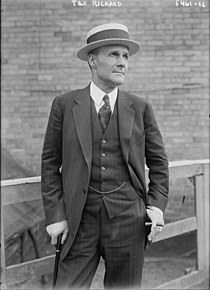
Tex Rickard

After its year long debut in Chicago, this revolver came into the hands on one Mr. Tex Rickard.  Tex was a wealthy man thanks to his gold mines.  Tex had traveled several times to Alaska after various discoveries of gold in Klondike and Nome.  After selling his holdings, he opened the Northern Saloon in Klondike, but would soon lose everything to gambling.  After working some odd jobs, he began promoting boxing matches and would eventually become one of the world's most well-known promoters.  He was the Don King of his day.  His excellence in promoting would lead him to start a life-long friendship with Wyatt Earp, promote for Heavyweight Champion Jack Dempsey, and bring boxing to its peak of popularity in the 1920's.  Before all of that, in 1906 Tex had chased the gold rush in a town recently renamed Goldfield.  There he started a bar named the Great Northern Saloon, a tribute to the bar he once lost, began his boxing promoter career, threw celebrations, and met a man named Claude C. Inman, to whom he would later give this pistol as a gift.  As his promoting career took off Tex would eventually obtain the rights to promote fights in Madison Square Garden, start the NHL New York Rangers hockey team, and build the third reincarnation of Madison Square Garden.


Claude C. Inman was a true pioneer.  He arrived in a mining camp named "Grandpa" with a load of lumber and the hunch that this area would soon strike a boom.  A tall, soft-spoken man he built the town's first frame building and drove its first nail with a bullet from his six shooter at thirty paces.  He would later call his demonstration "peace insurance."  Soon he would open for business as a carpenter and builder for the miners and their families, who were still living in tents at that time and paying him with everything but money.  Offered five times the sum required, he refused to build a saloon and instead focused on the town's first civic job: a water tank.  It wasn't too long before Inman brought back his family and started a life for himself in a town he had built with his own two hands.    Soon the town struck "high-grade" veins of gold, earning $200,000/ton, and the town boomed.  It changed its name to Goldfield and by 1904 it had produced about 800 tons of the lustrous ore.  Claude Inman held many hats in his town.  He was the first to organize labor in the area ($6/day and only 8 hours/day), he joined the school board in 1904, became the town's fire chief in 1905, battled several of the towns terrible fires in 1906, but shortly after was asked to take on a new job.

Goldfield, NV.  Notice the "Claude C. Inman for constable" banner over the street.

The town was booming and life in the Old West was tough.  20,000 people, twenty bars, access to gambling twenty-four hours a day, and a "red light district" with hundreds of prostitutes were all to be found in Goldfield.  It also had no shortage of opium dens, hoodlums, and miners stealing gold ore from the mines known as "highgraders."  Inman recalls that he "saw men on the way back from the mines with the handles on their lunch boxes bent like strings - they were that heavy with gold ore."  It didn't take long for the 350 mine owners to hold a meeting to discuss the problem, start cussing up a storm, and finally nominate Inman to clean up the town.  He wanted to talk to his wife, but the next morning the headlines already read 'INMAN ACCEPTS' even though Inman states, "Hell, I hadn't said a word."  January 1, 1906 Inman became the law for "a town that had more crooks and killers per capita than any other in American history; a town so fabulously rich that criminals from all over the world came to get a slice of its golden pie."  They persuaded Inman with an offer of pay that was a $10,000 per month guarantee or 40% of all the gold he recovered though Inman says, "There was never any more talk about the guarantee.  The percentage was always higher than $10,000."  After several "Untouchables" style raids and discoveries of secret trap doors, hidey holes, and other devices used to smuggle the gold (including travel trunks with secret compartments), the highgraders decided to hire a hitman to take out Inman.  It would not be the only time.  Inman describes it best.

"A little while after I took over the highgraders hired a man to get me.  I saw him when he came into town - sort of a dudish cuss.  I didn't let him see me and ducked into a saloon. Had a bar about 40, 50 feet long.  I remember the gaming tables.  A very nice place for that day and age.  Anyway, I had got down quite a ways behind the bar and was sitting there talking when somebody yelled 'Look out!'  I turned and this fellow started shooting.  There was something very peculiar and just that quick I realized that the fellow could not hit me.  I stepped behind the bar, waiting for the smoke to clear so I could do a little business.  He got two shots in - couldn't hit the side of a house...I commenced to get sore about this.  I stepped right out in full view and I walked right up to him and he stood there with the gun down at his side, smoking.  I told him not to raise his gun again, or I would kill him.  He didn't.
     He will never be more like a corpse than he was then.  The gun was down in his hand.  I walked up to him and took the gun out of his hand and laid it on the bar.  I said to the bartender, "Give us a drink.  'What are you doing there anyhow?'  He had been down in the metal tank under the bar.  The metal tanks had been built there, so that barkeepers could duck down.  He crawled out and was very peeved.  'You had better give us a drink.  This man's nerves are bad.  Put his gun out of the way.  He will never need it again."

After their drink, Inman took the man back to his office and "told him if he'd promise to get a decent job, I'd let him go.  He disappeared a few weeks later like a million others... He said 'I am going to remember this."  That was in 1906.  Two years later, in 1908, when I went to Boise to see this aviation meet, I was at the hotel and walked out, when I met a man face to face and he was spellbound.
     He said, "Aren't you Mr. Inman?"
     I said, "Yes."  He turned a liver color for a second.
     He said, "Do you know me?"
     I said, "I don't know you.  Your face is familiar, but I don't know you."
     He said, Have you got a minute to spare?  Come take a walk with me."  We went into the street and walked up the block and a half and there was a little store, nicely fixed up (electrical fixtures and plumbing).  We went in (his name was on the door) and it was a nice, clean, up-to-date store and full of goods and we took a glance around and walked on through and he opened another door in the back end of the store.
     He said, "My dear, come here.  I want to show you something."  There was a woman of small stature and with a curly-haired baby in her arms, with another girl about two years old by her side.
     He said, "Chief, this is my wife.  My dear, do you remember I told you about the policeman?"  She looked at me a minute and tears came streaming down her face.  I said, "You should not feel that way about it."
     She said, "I cannot help it.  You will never know what you have done for us."  This was the man that had come to Goldfield to kill me.  He had gone straight and was one of the highly respected men of the town and had a good business."


Inman even had Wyatt Earp himself offer his service for hire to clean up the town after he had so famously cleaned up Tombstone and Dodge City.  Earp nicknamed Goldfield "Hell's Flats" and urged Inman to allow him and a dozen men to root out the bad apples.  However, Inman knew they would be hopelessly outgunned and that the town couldn't be swept clean with the barrel of a gun.  Instead, he famously opted for capturing criminals instead of killing them, stings to catch them unaware, and using a conversational and pleasant demeanor.  Tex Rickard claimed once that Inman "could do more with friendly persuasion than most sheriffs could with a posse and make more friends than a politician at a banquet."  Maybe it was the way that Inman cleaned up the town, maybe it was the way he selflessly fought its disastrous fires, maybe it was the way he dealt with the Union mobs, or maybe it was the gentle way he spoke, but in February 1907 Goldfield paid tribute to the man that had done so much more them in a little over one year.  Inman was presented with the Smith & Wesson, Gustave Young engraved and gold inlaid, double action .44 Frontier revolver, that had been on display at Chicago's Columbian Exposition in 1893. However, to better show their appreciation, the townsfolk had luxurious Tiffany snakeskin grips put on the revolver by Tiffany & Co. in New York City.  Inman patrolled the town until January 1, 1909 when he retired a wealthy man.

The stories listed above are a mere drop in the bucket. The documentation that comes with this firearm truly give a glimpse into the life of this amazing man and his captivating, numerous stories.

After Inman
Claude Inman owned that revolver the rest of his life until he passed in July of 1962 and it passed to his son.  Since then it has passed through a few collections and appeared in several notable publications.  Perhaps most notably is is R.L. Wilson's The Peacemakers: Arms and Adventure in the American West.  From the 1893 Columbia Exhibition to the Gold Mines of Nevada, it now finds it path going through Rock Island Auction Company, the #1 firearms house in the world.  Whose collection will be fortunate enough to welcome this collectable with infinite tales to tell?  Will the new owner be able to add stories just as exciting?  Perhaps one day we'll find out or better yet, perhaps we'll go out and make some stories of our own.